

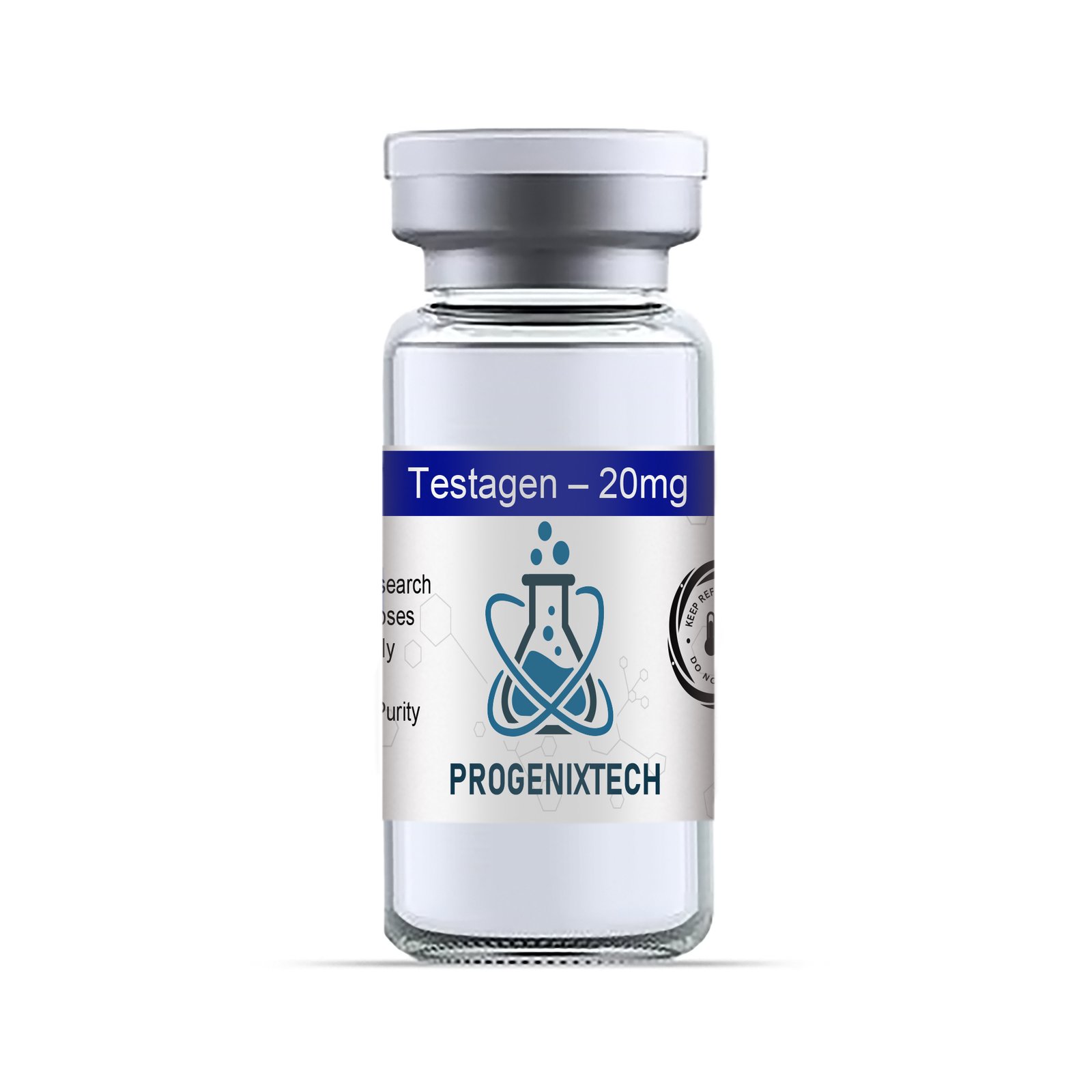
Description
Research Summary: Testagen Effects on Laboratory Rats
Product is sold for prescriber purposes only. Please handle with care and follow all safety guidelines for the specific chemicals involved.
Testagen is a thymic peptide complex derived from calf thymus, commonly investigated for its role in modulating immune function and promoting tissue regeneration. Preclinical studies using laboratory rats have demonstrated promising biological effects, particularly in the domains of immunoregulation, oxidative stress reduction, and cellular repair mechanisms.
In one study, administration of Testagen in rats resulted in enhanced immune system markers, including increased T-lymphocyte activity and normalization of thymic hormone levels. This suggests a potential application in age-related immunodeficiency and other conditions involving compromised immune function (Khavinson et al., 2003). Rats treated with Testagen showed improved resistance to induced stressors, indicating a stabilizing effect on the hypothalamic-pituitary-adrenal (HPA) axis.
Another study observed Testagen’s antioxidant properties in rats exposed to oxidative damage. Rats pre-treated with Testagen exhibited lower levels of lipid peroxidation markers and increased activity of superoxide dismutase (SOD), catalase, and glutathione peroxidase in liver tissue, indicating a systemic protective effect against free radical-induced damage (Trofimova et al., 2005).
Additionally, Testagen demonstrated regenerative potential in rats with experimentally induced muscle and tissue injury. Histological analysis revealed accelerated healing, improved collagen formation, and increased vascularization in affected tissues (Grigor’ev et al., 2008).
Collectively, these findings highlight Testagen’s multifactorial benefits in rats, including immune enhancement, antioxidant protection, and tissue regeneration. Further studies, including dose-response trials and toxicity evaluations, are warranted to confirm its translational potential for human therapeutics.
References (PubMed):
- Khavinson, V. K., et al. (2003). [Peptide bioregulators in aging: results and prospects]. Bull Exp Biol Med, 135(6), 519-521. https://pubmed.ncbi.nlm.nih.gov/14743718
- Trofimova, S. V., et al. (2005). [Correction of lipid peroxidation in rat liver by thymic peptides]. Bull Exp Biol Med, 139(3), 356-359. https://pubmed.ncbi.nlm.nih.gov/16142279
- Grigor’ev, E. I., et al. (2008). [Effect of peptide complexes on regeneration of skeletal muscle]. Bull Exp Biol Med, 146(1), 79-82. https://pubmed.ncbi.nlm.nih.gov/19308553